
Debt Collection Laws
A comprehensive guide on business debt collection laws, covering federal and state regulations, commercial debt practices, statutes of limitations, and industry best practices to ensure ethical, compliant, and effective debt recovery.
While federal law strictly protects individuals who incur consumer debts, businesses have far fewer safeguards regarding commercial debt collection. Some states have specific corporate debt collection laws relating to licensing requirements and statutes of limitations. However, the core frameworks for collecting commercial debts professionally are found in the codes of ethics established by premier industry associations.
This guide discusses business-to-business (B2B) debt collection laws in detail. You’ll learn about the limits of federal regulations, how commercial debt collection agencies operate, and the industry standards, membership requirements, and best practices that can optimize your accounts receivable recovery efforts.
What Are Debt Collection Laws?
Debt collection laws are the body of rules governing how creditors or third-party agencies recover outstanding balances. In a consumer context, these laws primarily shield individuals from harassment and deception. In a B2B context, the legal framework focuses more heavily on contract enforcement, corporate compliance, and state-level licensing.
Federal Law and the FDCPA
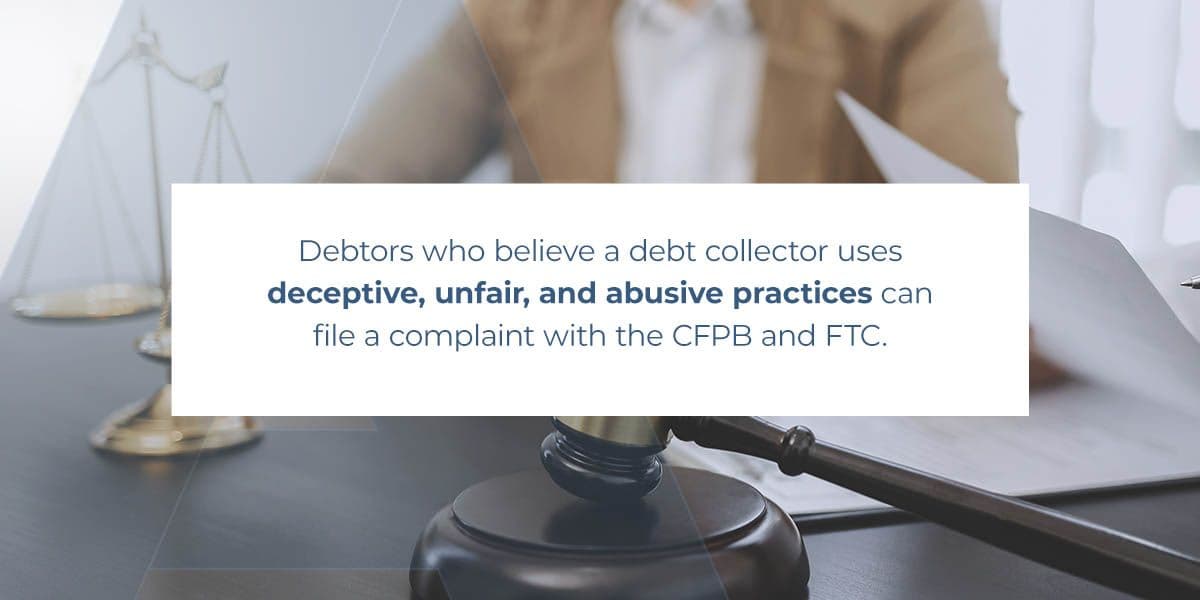
The primary federal debt collection law is the Fair Debt Collection Practices Act (FDCPA), which went into effect in 1978. Its core objective is to prevent deceptive, abusive, and unfair debt collection practices by:
- Defining the rights of individual consumers
- Providing strict behavioral guidelines for debt collectors
- Prescribing steep penalties for violations
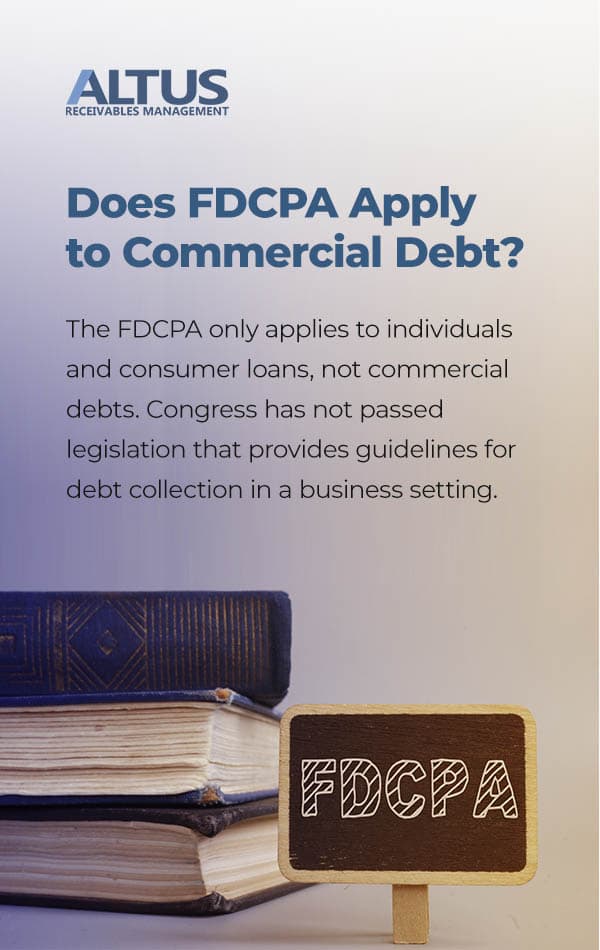
The B2B Exception: The FDCPA applies strictly to third-party debt collectors handling consumer debts (loans for personal, family, or household purposes). It does not apply to original creditors, nor does it regulate commercial debts. Currently, there is no federal equivalent to the FDCPA for business-to-business debt recovery.
While business debtors cannot file complaints with the Consumer Financial Protection Bureau (CFPB) under the FDCPA, predatory or fraudulent corporate collection tactics may still cross into unfair trade practices, which can be reported to the Federal Trade Commission (FTC) or a state’s attorney general.
State-Level B2B Regulations
Because federal oversight is limited in corporate collections, state laws dictate the legal landscape for B2B recovery. These typically focus on three areas:
- Statutes of limitations: Every state establishes a strict timeline within which a creditor must file a lawsuit to recover a debt. These periods vary significantly depending on the state jurisdiction and the nature of the debt contract.
- Permissible corporate practices: A handful of states extend certain fair-collection mandates to corporate debtors, preventing extreme deception or misrepresentation in business collections.
- Collection licensing requirements: Many states require commercial debt collection agencies to secure specific corporate licenses and bonds before operating within their borders.
Common Prohibited Practices Under Professional Standards
While the FDCPA doesn't legally bind B2B collectors, reputable commercial collection agencies mirror many of its baseline prohibitions to protect corporate reputations and avoid tort liability (such as harassment or tortious interference). These prohibited practices include:
- Contacting business owners or executives at highly unusual or disruptive hours.
- Flooding a business with excessive, repetitive calls designed to harass rather than negotiate.
- Contacting executives at unapproved locations if communication has been formally restricted.
- Threatening physical harm or unauthorized property seizure.
- Threatening legal proceedings or asset attachment without the explicit authorization or true intent of the creditor.
- Using abusive, profane, or provocative language during negotiations.
- Misrepresenting agency identity or using documentation that falsely implies a connection to the judicial system or a government entity.
- Releasing private corporate financial details to third parties or the public to force a payment.
What Defines a Commercial Debt?
A commercial (or B2B) debt is any financial obligation incurred by a business entity during its standard operations. These debts are typically leveraged to fund business activities, such as commercial expansion, inventory acquisition, equipment purchasing, or working capital.
Corporate lending transactions are governed by formal contracts detailing the principal amount, interest rates, repayment schedules, and default remedies. When a business defaults, the creditor is legally entitled to pursue enforcement actions. Crucially, these commercial enforcement laws apply uniformly, whether the debtor is a small local business or a major corporation.
How a Commercial Debt Collection Agency Operates
Commercial debt collection agencies act as specialized intermediaries, helping businesses recover outstanding B2B receivables from other companies. They employ trained commercial negotiators who leverage specialized technology and industry compliance knowledge to maximize recovery.
The process generally follows a structured workflow:
- Assignment: The creditor assigns the delinquent account to the agency under a contingency fee structure (a percentage of the recovered amount) or a flat-fee agreement.
- Demand & Dispute Resolution: The agency issues formal demand letters and initiates contact to uncover the root cause of the non-payment (e.g., cash flow issues, supply chain disputes).
- Settlement Negotiation: Collectors work to secure immediate payoff or structure enforceable commercial settlement agreements based on the debtor's corporate assets.
- Enforcement & Legal Escalation: If the debtor refuses to cooperate, the agency can recommend escalating the matter to commercial litigation attorneys to secure court-ordered asset attachments or bank levies.
Maintaining compliance throughout this process protects the creditor from counter-lawsuits and preserves valuable business relationships.
Industry Oversight: Self-Regulation in B2B Collections
Because there is no federal FDCPA for business debt, the commercial collection industry heavily relies on elite professional associations to enforce ethics, verify financial security, and protect creditors.
1. Commercial Collection Agencies of America (CCA of A)
The Commercial Collection Agencies of America is a premier certifying body that establishes operational standards for corporate asset recovery. Certified members are strictly required to adhere to an independent standards board and a rigorous Code of Ethics.
Key compliance mandates for CCA of A members include:
- Practicing absolute honesty, fairness, and professional courtesy in all corporate negotiations.
- Refraining from any deceptive statements, misleading demand materials, or actions that bring reproach to the industry.
- Declining to perform unauthorized legal duties or give legal advice.
- Promptly complying with a business debtor’s request for formal debt verification.
- Maintaining complete professionalism by avoiding harassment, threats, or unauthorized contact with the debtor’s vendors and banks.
2. Commercial Collection Agency Association (CCAA)
The CCAA operates as a specialized division of the Commercial Law League of America (CLLA). Established in 1972, it is one of the oldest regulatory bodies in commercial finance. To earn and maintain agency membership, an organization must pass rigorous operational vetting:
Membership Requirement · B2B Operational Standard
Industry Tenure: Must be actively established in commercial collections for at least 4 consecutive years.
B2B Focus: A minimum of 80% of the agency's total collection volume must be strictly commercial.
Financial Safeguards: Must maintain a dedicated, separate Trust Account for all client funds.
Bonding Security: Must post a surety bond of at least $300,000 to insulate creditors from risk.
Oversight: Must consent to random, unannounced periodic site visits and operational audits.
Executive Education: Leadership must earn 60 continuing education credits annually in commercial law.
Navigating the Statute of Limitations on Corporate Debt
A statute of limitations dictates the exact window of time a business has to file a lawsuit to enforce a contract or collect a balance. The clock typically begins ticking the moment a payment obligation is breached. If this deadline passes, the debt becomes "statute-barred," and the creditor loses the right to seek a legal remedy in court.
Crucial B2B Caveat: A statute of limitations can be completely reset if the debtor makes even a partial payment or signs a formal written acknowledgment of the debt before the deadline expires.
The specific limitation periods depend on state law and how the B2B transaction was structured:
- Written Contracts: The absolute standard in B2B commerce. These comprehensive agreements explicitly detail the rights, interest rates, and payment parameters of both corporate parties.
- Open-Ended Accounts: This covers commercial lines of credit, corporate credit cards, and revolving supply accounts. The limitation period often floats based on the date of the last invoice or account activity.
- Promissory Notes: Formal financial instruments containing an unconditional written promise to pay a specific sum. They are legally distinct from standard trade contracts and often carry different statutory deadlines.
- Oral Agreements: Verbal supply or service agreements. While legally binding in many jurisdictions, they are rare in enterprise B2B transactions due to evidentiary challenges and much shorter statutes of limitations.
11 B2B Debt Collection Best Practices
Managing corporate receivables requires a delicate balance between assertive asset recovery and relationship management. Implementing these eleven corporate best practices can drastically optimize your commercial recovery rates:

- Strategic Communication: Maintain absolute professionalism. Avoid aggressive or emotional tactics, clearly outline the corporate breach, and focus on practical B2B solutions.
- Rigorous Documentation: Maintain a flawless paper trail. Retain all purchase orders, signed bills of lading, master service agreements (MSAs), and email correspondence to quickly defeat debtor disputes.
- Proactive Compliance: Ensure your internal teams and external agency partners align strictly with individual state licensing laws to eliminate compliance risks.
- Structured Negotiation: Be prepared to pivot to structured payment plans or lump-sum settlements. Resolving a cash flow bottleneck via a mutual agreement is faster and more cost-effective than protracted litigation.
- Early Intervention: Do not let aging receivables sit. The probability of successful B2B recovery drops significantly after an invoice passes 60 to 90 days past due.
- Executive Professionalism: Protect your brand. Corporate collections require a sophisticated corporate approach; heavy-handed consumer-style tactics will permanently alienate industry partners.
- Continuous Staff Training: Regularly train internal credit and collection teams on commercial credit law, contract terms, and dispute negotiation strategies.
- Clear Escalation Procedures: Establish automated internal milestones (e.g., Day 15: Past Due Notice; Day 45: Executive Call; Day 75: Third-Party Agency Placement) to remove hesitation from the recovery process.
- Empathy-Driven Customer Service: Understand the debtor’s operational realities. Identifying whether a non-payment is caused by a temporary supply chain gap or systemic insolvency allows you to deploy the right strategy.
- Corporate Risk Assessment: Continuously pull corporate credit profiles, monitor UCC filings, and assess a delinquent debtor's asset health to prioritize high-value recovery targets.
- Professional Outsourcing: Recognize when internal efforts have peaked. Partnering with a dedicated B2B collection agency frees up your internal accounts receivable teams and brings heavy-duty legal resources to the table.
Partner with Altus for Specialized B2B Debt Collection
Because the consumer-focused FDCPA does not apply to commercial transactions, navigating the complex web of state licensing, corporate contracts, and industry compliance requires a specialized B2B partner. To protect your brand and maximize cash flow, your business needs an agency rooted deeply in commercial collection regulations.
Altus is a premier commercial debt collection agency providing enterprise-grade recovery solutions nationwide. As a fully certified member of both the Commercial Collection Agencies of America and the CCAA, our licensed professionals adhere to the highest codes of corporate ethics.
Let us help you build structured, compliant recovery workflows that safeguard your bottom line. Contact Altus today to optimize your commercial cash flow.
Additional Commercial Credit Resources
- What Are Collection Litigation Services?
- How Does International B2B Debt Collection Work?
- Commercial Debt Validation: Facts and Frameworks
FAQs
1. Does the FDCPA apply to business-to-business (B2B) debt collection?
No. The Fair Debt Collection Practices Act (FDCPA) applies strictly to consumer debts incurred for personal, family, or household purposes. There is currently no federal equivalent to the FDCPA that regulates commercial or B2B debt collection.
2. How are commercial debt collection practices regulated if federal law doesn't apply?
Commercial debt collection is primarily regulated at the state level through corporate licensing requirements, bonding mandates, and state-specific statutes of limitations. Additionally, reputable B2B agencies self-regulate by adhering to strict codes of ethics enforced by certifying bodies like the Commercial Collection Agencies of America.
3. What happens if the statute of limitations expires on a commercial debt?
Once the statute of limitations passes, the debt becomes "statute-barred," meaning the creditor loses the legal right to sue the debtor company in court. However, a statute of limitations can often be completely reset if the debtor makes a partial payment or signs a written acknowledgment of the debt before the deadline.

4. What is the difference between a consumer and a commercial collection agency?
Consumer agencies deal with individuals and must navigate strict federal protections (FDCPA). Commercial (B2B) agencies work exclusively with business entities, requiring deep expertise in corporate contract law, Uniform Commercial Code (UCC) filings, and business asset analysis to resolve complex corporate disputes.
5. Why should a business look for a certified commercial collection agency?
Certification from associations like the CCA of A or CCAA guarantees that the agency meets rigorous operational standards. This includes maintaining a dedicated trust account for client funds, holding a substantial surety bond to protect the creditor's money, and passing random, independent audits.



Ready?
Put this to work on your receivables.
Talk to Altus about the accounts sitting in your aging report right now.